
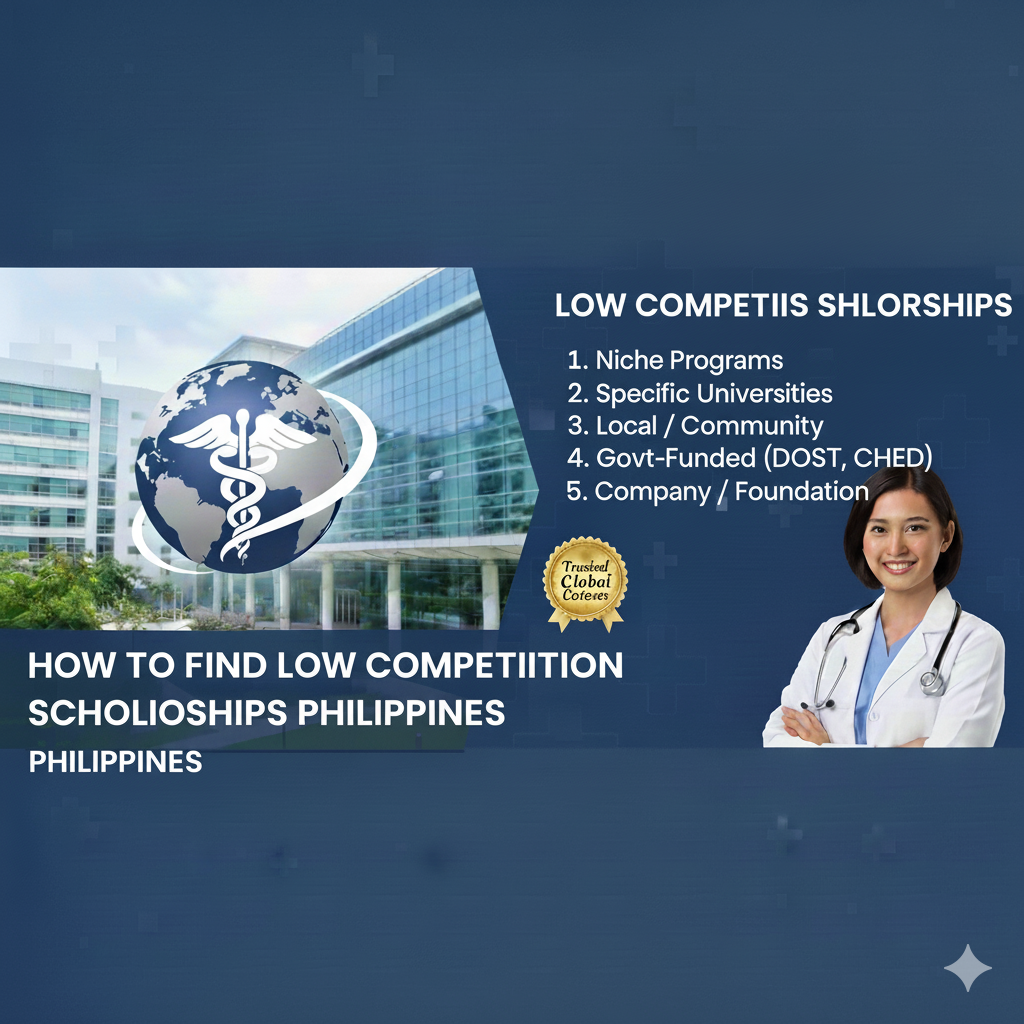
How to find low competition scholarships philippines
Introduction
If you’re seeking financial support for your education in the Philippines, you’ll want to know exactly how to find low competition scholarships Philippines that give you an edge. This article walks you through effective methods on how to find low competition scholarships Philippines, giving you a roadmap to uncovering lesser-known opportunities. Whether you’re a high-school graduate or a college student, learning how to find low competition scholarships Philippines can make a big difference in your success.
Many students focus only on the big national scholarships, which means heavy competition and fewer chances. By contrast, knowing how to find low competition scholarships Philippines means you can tap into smaller, less-crowded awards—raising your odds. In the following sections you’ll learn what “low competition” really means in the Philippine context, where to search, how to evaluate opportunities, and how to apply smartly.
Let’s dive into the strategies and actionable tips you need. With this guide you’ll be equipped to search broadly, apply wisely, and increase your chances of landing a scholarship by mastering how to find low competition scholarships Philippines.
What do we mean by “low competition scholarships”?
Low competition scholarships are awards that fewer applicants pursue—often because they are niche, local, or less-publicised. The benefit: fewer competitors means a higher chance to win. According to scholarship-search guides, smaller community or local awards, industry-specific or lesser-advertised grants tend to have lower application volumes. Scholarship Scoop+1
In the Philippine context you’ll find them in city or provincial government grants, small company CSR scholarships, or school-based endowments. These may not cover massive amounts, but they often fill tuition gaps and are far less competitive than national programs like those from CHED or DOST‑SEI.
Step 1: Identify niche and local opportunities
One key method on how to find low competition scholarships Philippines is to cast your net beyond the major portals. Here are specific sources:
-
Local government units (LGUs): Check your city or province website for “scholarship programs” or “educational grants”.
-
School-internal scholarships: Ask your senior high school or university registrar about internal funds or partner foundations. Philippine Scholar+1
-
Small company or foundation CSR scholarships: Smaller firms often offer awards to students from their locality.
-
Less publicised online announcements: Some scholarship lists note that using search terms like “scholarships no one is applying for” helps. Scholarship Scoop
By broadening your search using these angles, you’ll find many of the hidden gems.
Step 2: Use smart search strategies
To systematically search and capture the lesser-competed awards, follow these tactics:
-
Create keyword alerts such as “scholarship (your city/province) 2025”, “educational grant ___ barangay”, “foundation scholarship for students in ___ region”.
-
Use scholarship directories in the Philippines (such as those by PhilEdukasyon) to filter by region, criteria and deadlines. philedukasyon.com
-
Search for “easy scholarships to apply for” in the Philippines—as many of those are lower competition. chedscholarships.org
-
Network: talk to your guidance counsellor, school registrar, local barangay office—they may have lists not widely published.
Following these methods enhances your ability to uncover opportunities others miss—key to how to find low competition scholarships Philippines.
Step 3: Evaluate & prioritise the right ones
Once you have a list, you must decide which ones to target. Use this vetting process:
-
Application scope & publicity: Awards limited to a small region or particular school tend to have less competition.
-
Eligibility clarity: Niche eligibility (e.g., students in a particular course, or residents of a barangay) means fewer applicants.
-
Documentation requirements: Simple requirements often indicate fewer applicants. The “easy scholarships” list mentions programs that don’t require high grades or extensive essays. chedscholarships.org
-
Coverage vs. effort: If the benefit is decent and the application ask is low-effort, even a modest award can be worth going after.
-
Deadline and timeline fit: Choose ones you can realistically prepare for rather than last-minute rush.
By applying this filter, you’ll have a targeted list of scholarships with better odds—another step in mastering how to find low competition scholarships Philippines.
Step 4: Prepare application to increase your odds
Even for lower competition awards, you still need a strong application. Here are tips:
-
Gather documents early: Birth certificate, transcript/report card, barangay certificate, income certificate. Many Philippine-based programs list these as required. moneymax.ph+1
-
Tailor your goal statement/essay: Even for small awards, a compelling reason why you deserve it helps you stand out.
-
Highlight your local context: Since many “low competition” awards are local, show how you fit the region/community and how you’ll give back.
-
Submit before the deadline: This is basic but ensures you don’t lose out due to technicalities.
-
Apply to several: The nature of low competition doesn’t guarantee success, so increase your chances by applying to multiple opportunities simultaneously.
This step ensures that you not only find the opportunity but also make the most of it.
FAQs
Q1: What qualifies as a low competition scholarship in the Philippines?
A: It’s typically a scholarship with narrow eligibility (local region, specific school, small foundation), or fewer applications because it’s less well-advertised. These usually have less applicant crowding.
Q2: Are the benefits of low competition scholarships smaller?
A: Often yes—they may provide partial-tuition or smaller allowances. But their real value is the higher chance of winning, which can still significantly help your education.
Q3: How many should I apply to?
A: As many as you can manage—especially those you qualify easily for. The more you apply, the better your odds. The search strategy guides emphasize quantity plus quality. Reddit+1
Q4: When should I start looking for these scholarships?
A: Start early. Scholarship portals in the Philippines recommend checking continuously—even once you are in college. uAspire+1
Q5: How do I know a scholarship is legit?
A: Verify via official websites (school, LGU, foundation), check for required documents, avoid ones that ask for a processing fee, and cross-check with your school’s guidance office.
Common mistakes to avoid
-
Limiting your search to only large national scholarships (which have heavy competition).
-
Applying only when last minute arrives—many lower-competition awards are overlooked early.
-
Ignoring local or school-specific grants—they often have fewer applicants.
-
Submitting a generic application—for niche awards you need to show fit with the eligibility.
-
Assuming winners are guaranteed—still prepare well and apply broadly.
Conclusion ON How to find low competition scholarships philippines
Learning how to find low competition scholarships Philippines puts you in a stronger position than many students who focus only on the “big” national awards. By searching locally, using smart keywords, vetting the right opportunities, preparing a strong application, and avoiding common mistakes, you improve your chance of success. Keep applying the principles here and you’ll gain confidence on how to find low competition scholarships Philippines, giving you access to promising funding options. Take action today, pursue multiple opportunities, and leverage your local context to master how to find low competition scholarships Philippines. Good luck!